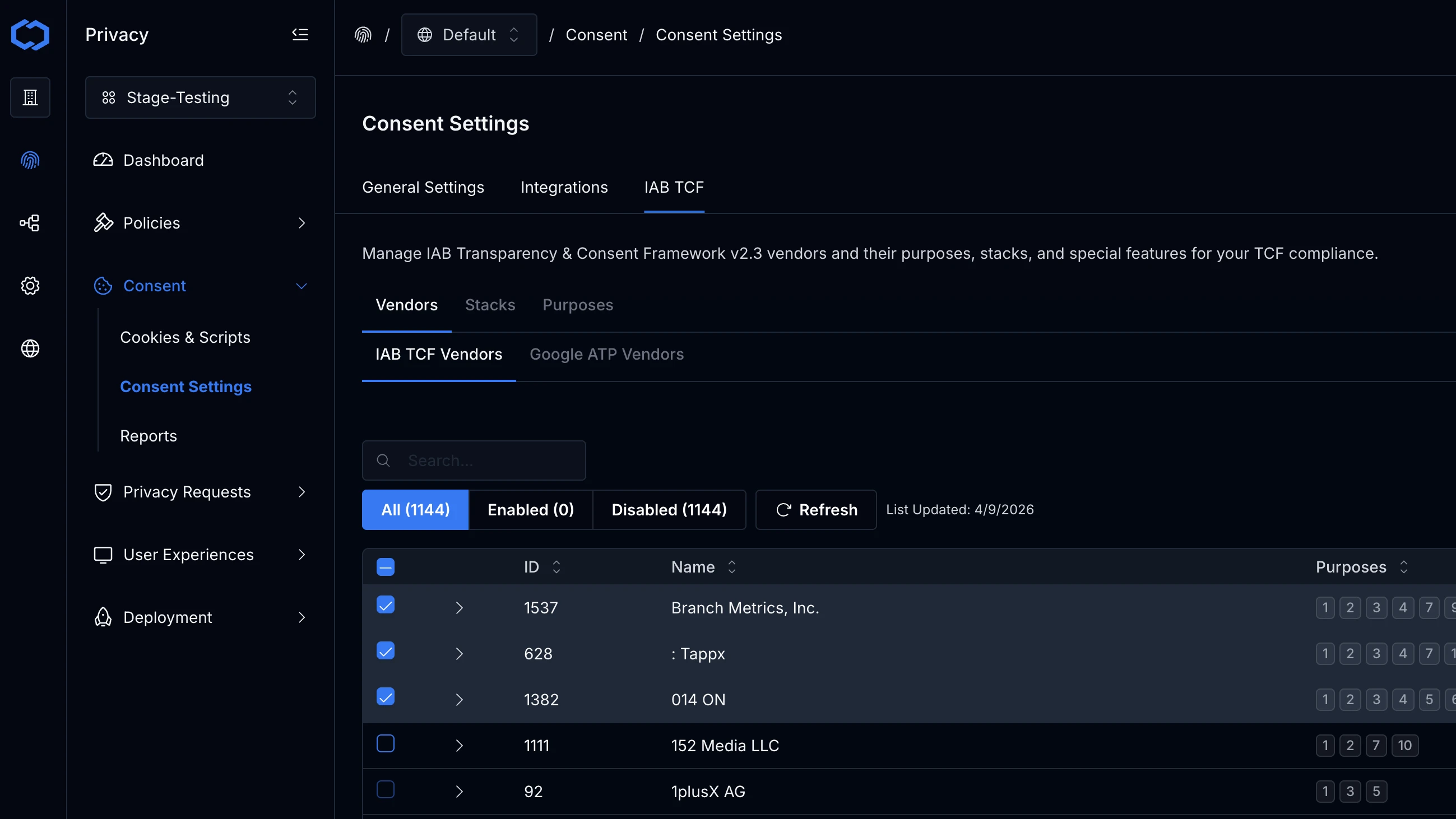
IAB TCF 2.4 Certified CMP
Deliver transparent consent experiences that meet IAB TCF 2.4 requirements while keeping your marketing stack performing.
Built for IAB TCF 2.4
Capture consent for purposes and features aligned with the latest IAB framework requirements.
Vendor & Purpose Controls
Manage global vendors, purposes, and legitimate interest in one place with auditable consent records.
Connected Adtech Integrations
Sync consent signals across your advertising stack, including Google Consent Mode and popular tag managers.
Everything You Need for IAB Readiness
Map purposes, vendors, and regional rules without custom engineering. Concord keeps your consent surfaces compliant as the framework evolves.
Full Purpose Coverage
Out-of-the-box support for vendors, purposes, stacks, Google ATP vendors, and more, with granular controls.
Vendor Governance
Manage global vendors and custom vendors with geographic rules, easy updates, and audit-ready histories.
Signal Delivery
Keep downstream platforms aligned with TC strings using prebuilt connections, webhooks, and tag templates.
Launch a TCF-Compliant CMP in 3 Easy Steps
Use Concord to stand up an IAB TCF 2.4 experience in minutes, complete with translations, geo rules, and consent logging.
- 1
Start Your TCF Project in Minutes
Sign up to Concord and launch your first project with TCF-ready defaults, geo controls, and banner templates.
- 2
Configure Vendors & Policies
Select relevant vendors, purposes, and features, then tailor banner copy, translations, and styling to match your brand.
- 3
Publish & Monitor Compliance
Deploy Concord via our integrations or a single line of code, then monitor consent rates and audit trails with confidence.
Related Resources
- Configuring IAB TCF v2.4
Modes, vendors, stacks, legitimate interest, testing, and troubleshooting.
- What Is the IAB TCF
Why the framework exists, why the version matters, and whether you need it.
- Google Consent Mode
Consent Mode V2, basic and advanced modes, and the Gold Certified CMP Partner status.
- UET Consent Mode
Consent signals for Microsoft Advertising and Clarity.
- Consent Mode Scanner
Check which consent signals your site sends to Google today.
- Concord Privacy Pricing
Compare plans for consent management and privacy requests.
Frequently Asked Questions
The IAB Europe Transparency and Consent Framework (TCF) is the advertising industry’s standard for collecting a visitor’s consent and passing it to ad vendors in a TC String. IAB Europe describes it as an accountability tool that supports compliance with parts of the GDPR and the ePrivacy Directive.
Concord supports IAB TCF v2.4, the current version. You can choose IAB TCF v2.4, or IAB TCF v2.4 with Google ATP to add Google Additional Technology Providers. TCF is disabled by default.
IAB Europe published TCF Specifications v2.4 and the matching Global Vendor List update on July 23, 2026. The vendor list now carries standard explanations and illustrations for each feature, and Special Feature 2 has a new name, so banners show clearer, standardized disclosures.
IAB Europe set a transition deadline of February 28, 2026. From March 1, 2026, any TC String created without the disclosedVendors segment is deemed invalid. TCF v2.3 made that segment mandatory and v2.4 keeps it, so the way to stay current is to run a CMP that generates current-version strings.
IAB Europe set October 23, 2026 as the deadline for CMPs to implement the new v2.4 disclosures on the web, and February 23, 2027 for mobile apps and CTV. Concord already supports TCF v2.4.
A CMP must register with IAB Europe, through an annual membership, to take part in the TCF. Concord is a registered CMP (ID 491), so Google Ad Manager and other vendors can read the TC Strings it generates.
It depends on how you use them. Publishers that serve personalized ads through AdSense, Ad Manager, or AdMob in the EEA, the UK, or Switzerland must use a Google-certified CMP integrated with the TCF. If you only advertise and measure, Concord also supports Google Consent Mode with or without the TCF.
Call __tcfapi with the ping command in the browser console and look for cmpLoaded set to true. Then call getTCData after interacting with the banner and confirm the tcString and the vendor and purpose consents match your choices.
When on, visitors see separate controls for consent and legitimate interest on applicable purposes, and Concord never grants legitimate interest automatically. When off, only consent controls appear and all processing requires explicit consent.
Yes. Google’s Additional Consent Mode is a temporary specification alongside the TCF for ad tech providers on Google’s list that are not yet on the Global Vendor List. Concord’s IAB TCF v2.4 with Google ATP mode generates both TC Strings and AC Strings.
Yes, if you turn on the Allow Google Consent Mode to read TCF signals setting. Google then infers ad_storage, ad_user_data, and ad_personalization from the TC String. The setting is off by default, and analytics_storage is still driven by Google Consent Mode.
Yes. Microsoft accepts the TCF as an alternative to UET Consent Mode for visitors from the EEA, the UK, and Switzerland. Add Microsoft (Vendor ID 1126) and Xandr (Vendor ID 32) to your vendor list, and use either the TCF or Consent Mode, never both.
If cross-device identity is enabled for your organization, yes. A visitor who grants consent on a laptop has the same TCF consent applied on a phone once identified, with no extra TCF configuration.
Lean on Experts Who Know IAB TCF
Our privacy specialists help you map TCF purposes to your data uses, configure vendors, and align stakeholders on consent operations.
- Expert guidance on mapping IAB purposes to your data uses.
- Assistance configuring multi-region experiences alongside TCF.
- Ongoing monitoring to keep vendor lists and notices up to date.
Chat live at admin.concord.tech or email hello@concord.tech