Answer Faster, or Get Asked Less
Loopio is a response factory: it makes answering quicker, but every questionnaire still reaches a person. Without a trust center there is no deflection layer, and seat pricing means volume never lowers the cost.
Deflect Before You Respond
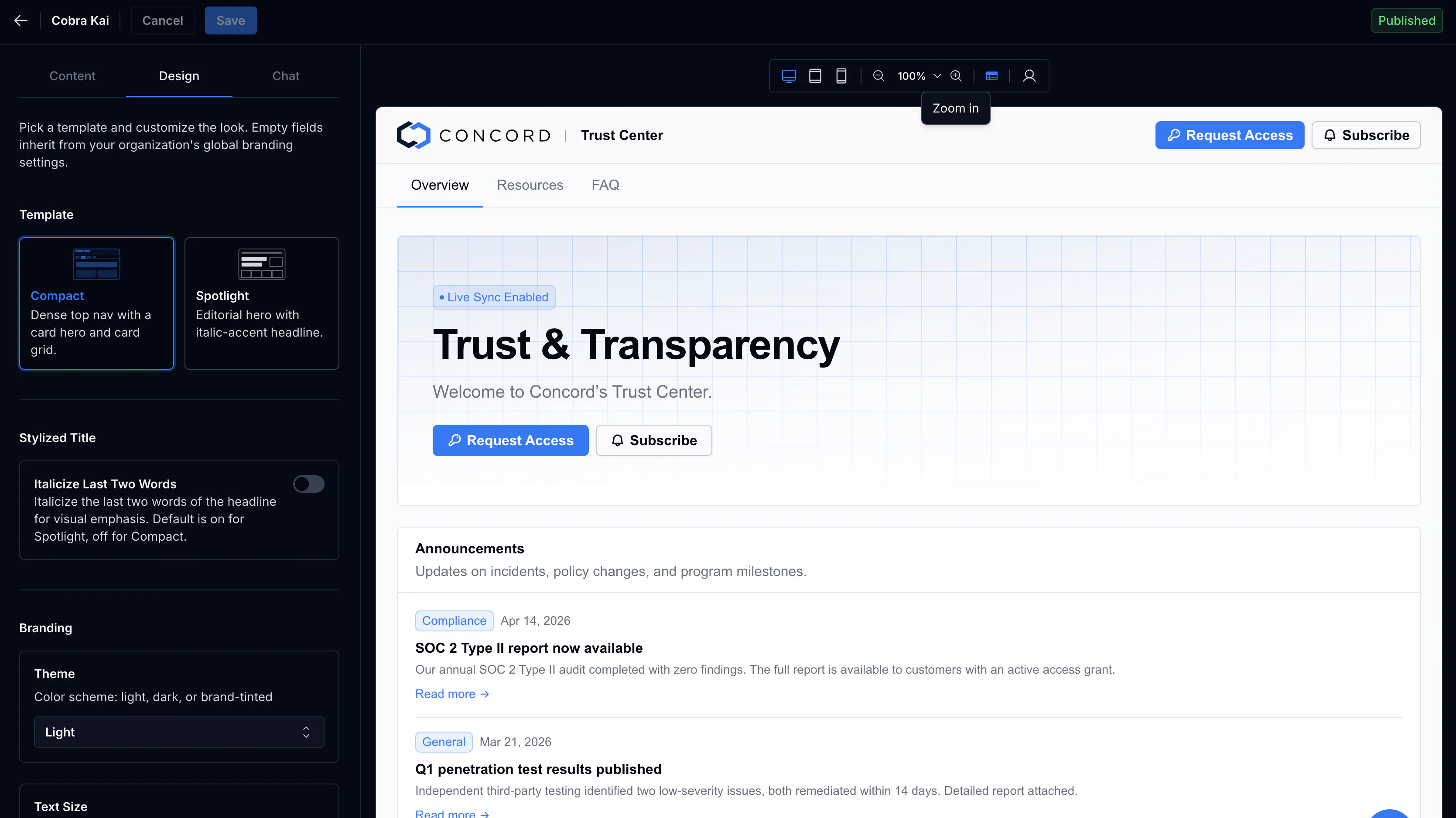
A public trust center with AI chat and NDA-gated documents answers most buyer questions before anyone sends a spreadsheet. Loopio has no trust center.
Priced on Reach, Not Headcount
Loopio meters named seats, so a team answering 500 reviews pays the same as one answering 50. Concord prices on the external companies your trust center serves.
Agents That Learn, Not a Library You Groom
Auto-RAG indexes documents on upload and corrections change future answers, instead of a content library someone has to curate every quarter.
Built for teams whose deals wait on the security review
Built to Close the Deal, Not Pass the Audit
A trust center is a sales asset. Buyers self-serve the documents, answer their own questions, and stop holding your pipeline while a questionnaire sits unopened in an inbox.
Buyers Verify on Their Own Terms
AI chat on the public trust center, 1-click NDA with a release ID and content hash stamped at signature, and gated documents with approval workflows. No waiting on your team.
AI-Native, Not AI Bolted On
Agents draft questionnaires and RFPs, learn from every correction, and answer buyers on your trust center. Connect Claude, ChatGPT, or any MCP assistant to ask across your trust data directly.
Start on the Trust Center, Grow Into Compliance
Land on a modern trust center today, then add controls, evidence, frameworks, and an auditor portal on the same platform as your program matures. One vendor, from your first questionnaire to your next audit.
One Update, Everywhere It Appears
Documents, policies, and FAQs live once in a versioned data layer behind the Trust Center, the AI chat, questionnaire drafts, and RFP responses. No re-uploading, no third place where the old answer survives.
Published Pricing, No Sales Gate
A public slider priced on external companies reached, not seats, with a stated overage rate. Transparent pricing has been the number one vendor ask from B2B buyers four years running (TrustRadius).
Concord vs. Loopio, at a glance
| Feature | Concord | Loopio |
|---|---|---|
| Public Trust CenterThe deflection layer | Included | Not included |
| AI Questionnaire Automation | Included | Included |
| RFP / RFX Automation | Included | Included |
| AI Assistant Access (MCP)Query your trust data from Claude or ChatGPT | Included | Not included |
| Pricing Meter | External Companies Reached | Named Seats |
| Cost Scales With Review Volume | Yes, With Reach | No, Volume Is Free but Seats Are Not |
| Buyer-Facing AI Chat | Included | Not included |
| 1-Click NDA | Included | Not included |
| Knowledge Base Upkeep | Auto-RAG on Upload | Curated Library |
| Published Pricing | Public Slider + Overage Rate | Quote Only |
| Free Tier | Branded Domain, Gated Access | Not included |
| Security Controls & Evidence | Included | Not included |
| Versioned Policy BuilderTemplate library, versioning, approvals | Included | Not included |
| Connected Privacy PlatformConsent, DSARs, policies, data mapping | Included | Not included |
Add the deflection layer Loopio does not have
- Publish a branded trust center so routine questions never reach a person
- Import your Loopio library; auto-RAG indexes it on upload with no manual curation
- Move from per-seat licensing to pricing based on the companies you actually serve
- Keep RFP response automation, which Concord also covers
Frequently asked questions
No. Loopio confirms this in its own content. It is response automation for RFPs, DDQs, and security questionnaires, which makes answering faster but does not reduce how many questions arrive. A trust center is the deflection layer that stops routine questions from becoming questionnaires at all.
Loopio prices on named users, with incremental seats commonly in the range of $75 to $120 per user per month and buyer-reported deals that start in the five figures. Projects and questionnaires are unlimited, so a team fielding 500 reviews pays the same as one fielding 50 at equal headcount. Concord prices on external companies reached, starting at $199 per month for 100, so the bill follows the value rather than the size of your team.
Concord automates RFP and RFX responses, drafting from your knowledge base with citations and flagging gaps. Loopio is a broader and more mature proposal platform, with deeper project management, collaboration, and content-library workflows for large proposal teams. If RFPs are the majority of your work and you have a dedicated proposal function, Loopio is the deeper tool.
You can, though many teams do not need to. Concord handles the security reviews end to end: deflection, questionnaires, and RFPs. Loopio earns its place only if you run a dedicated proposal desk with large, multi-author proposals; if that is you, keep Loopio for those and let Concord own the security-review layer.
Export it and upload it. Auto-RAG extracts, chunks, embeds, and indexes the content automatically, so there is no re-tagging step. From then on your team approves or corrects drafts, and each correction changes how the system answers next time rather than requiring a library edit.
Beyond deflecting and answering security reviews, the same platform adds controls, evidence, frameworks (including AI governance standards like ISO/IEC 42001 and the NIST AI RMF), and a scoped auditor portal, so the trust center grows into a compliance program. Loopio stays deeper for large, collaborative proposal work, with project routing and content-library governance for a dedicated proposal team; Concord is built around the security review and what comes after it, not the RFP desk.